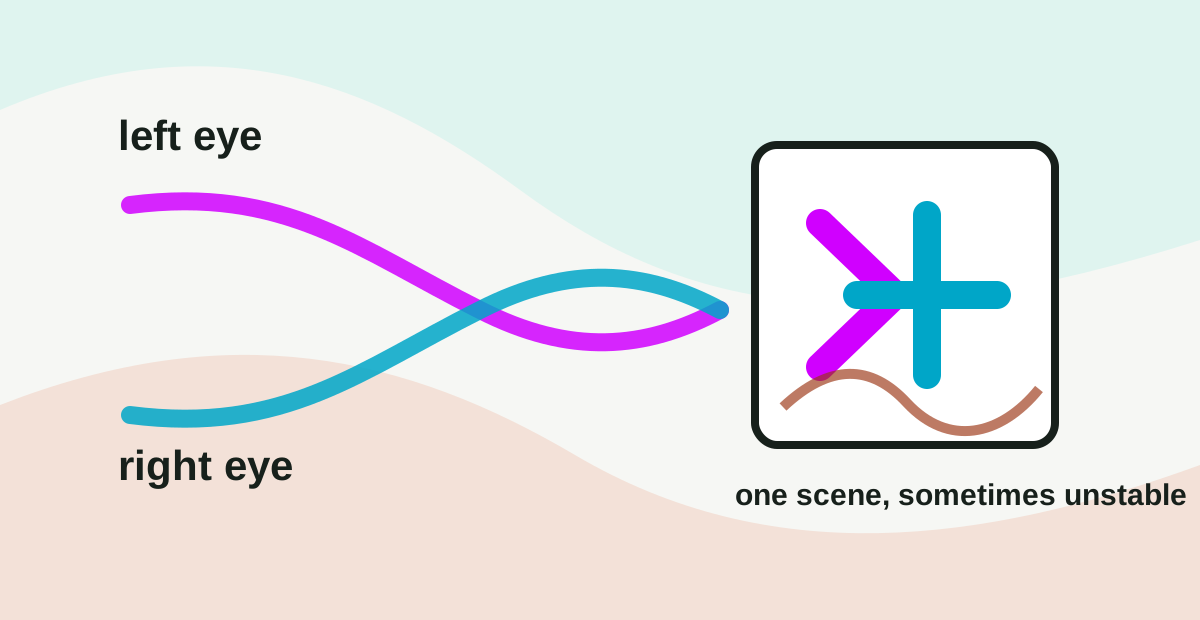
From fusion to rivalry
The brain usually behaves like a careful editor. Each eye sends a slightly different picture, and the visual system combines the differences into one useful scene. This ordinary cooperation is fusion: the left and right images are close enough that the brain can bind them together. Fusion supports the sense of depth that makes a coffee cup feel round instead of flat.
Fusion is not all-or-nothing. With small disagreements, perception can become partial fusion: some features combine while others look unstable, doubled, transparent, or strangely weak. Push the disagreement further and the system may use suppression, which means one input is reduced or kept out of awareness while the other carries perception for a moment. When neither input can settle the argument, the result can become binocular rivalry: conscious perception alternates between the two images even though the images on the eyes remain unchanged.1
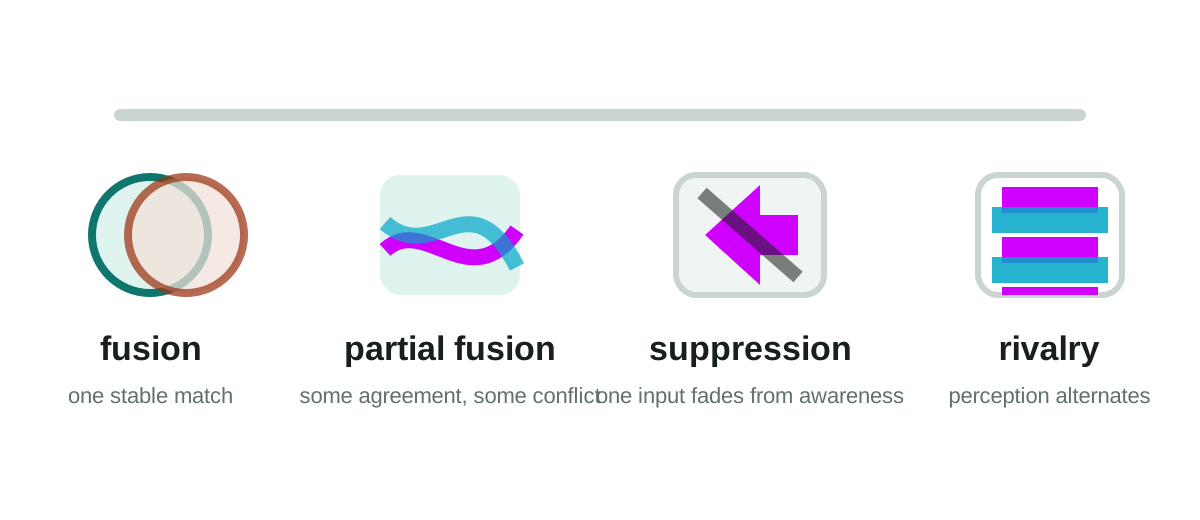
Think of the two eyes as two musicians trying to play together. If their notes harmonize, you hear one chord. If they drift apart, you may hear a rough blend. If one is much louder, the other is masked. If both insist on incompatible melodies, your attention may swing back and forth between them. In rivalry research, the visible image is said to be in dominance; the less visible image is suppressed.
The road from retina to motion and color
Vision begins in the retina, a thin neural sheet at the back of each eye. Photoreceptors respond to light, and retinal ganglion cells send signals out through the optic nerve. At the optic chiasm, fibers from the nasal side of each retina cross to the opposite side, so each half of the brain receives information from the opposite half of visual space.
Many of those signals pass through the lateral geniculate nucleus, or LGN, a layered thalamic station that relays and regulates visual input before cortex. From there, signals reach V1, the primary visual cortex. V1 is often described as the first major cortical map of the visual world. Later areas, including V2 and V3, elaborate contours, surfaces, and spatial organization. V4 is strongly associated with color and object form, while MT is strongly associated with motion processing.1
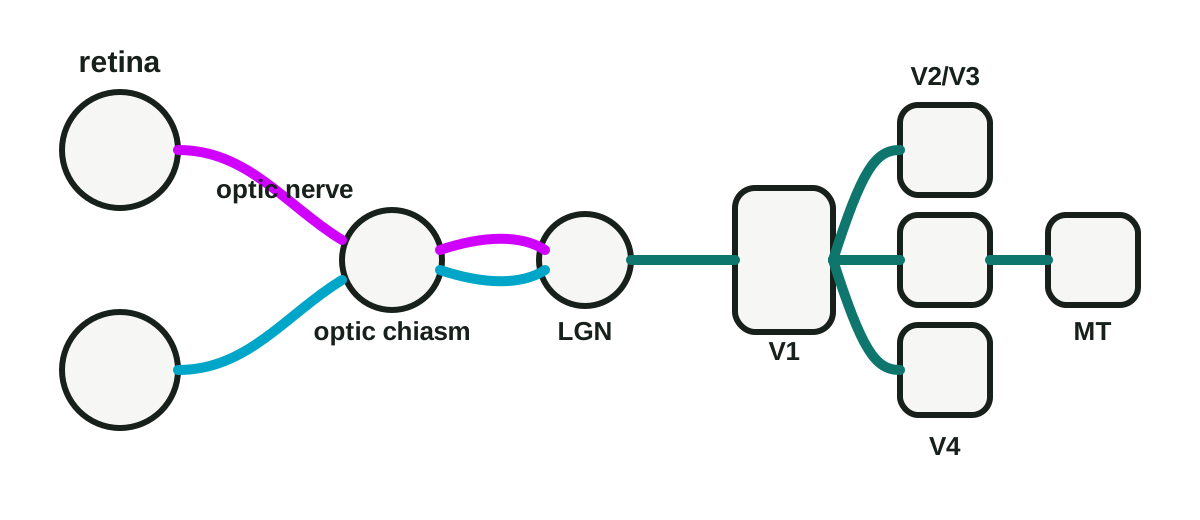
This path is not a simple camera cable. It is more like a city of workshops passing sketches, measurements, and guesses between rooms. Eye-of-origin information can matter early, but rivalry also involves later stages where patterns, objects, surfaces, and attention shape what wins awareness.3
What is competing?
Older accounts often asked whether rivalry is an eye-based contest or an image-based contest. In an eye-based view, the conflict is anchored in channels that still know which eye supplied the input. In an image-based view, the contest is less about the eye and more about incompatible patterns or objects. A classic local model uses reciprocal inhibition: neural populations representing one view inhibit populations representing the other, while adaptation slowly weakens the current winner.
Modern models tend to be less loyal to one level. Multi-level accounts treat rivalry as distributed: early local conflicts help trigger rivalry, while grouping, surface organization, and higher visual areas help decide how dominance spreads.3 Predictive or probabilistic accounts frame rivalry as a problem of inference. The brain prefers a single coherent cause for its sensory input. When neither interpretation can explain everything, perception becomes unstable and alternates between hypotheses.4
Levelt's propositions, first developed in the 1960s and revisited in modern reviews, remain a landmark because they connect stimulus strength with dominance and alternation behavior.2 They also remind us that rivalry is not just a philosophical curiosity. It is measurable, patterned, and still difficult enough to keep models honest.
Can you choose what wins?
Attention matters, but it is not a magic steering wheel. People can bias rivalry by attending to one stimulus, by performing tasks tied to one image, or by changing how strongly a stimulus is represented. But most observers cannot simply command one image to stay dominant forever. Rivalry keeps some of its automatic rhythm.7
It helps to separate voluntary attention from involuntary capture. Voluntary attention is the act of trying to favor one feature, location, or object. Involuntary attention is pulled by sudden changes, contrast, motion, or salience. Both can tilt the stage, but the actors are still the rival signals and the visual circuits that arbitrate them. Artfully speaking, attention is the spotlight, not the playwright.
Piecemeal rivalry
Rivalry is often introduced as if the whole left-eye image and the whole right-eye image take turns. Real perception can be messier. In piecemeal rivalry, one region of the visual field may be dominated by one image while another region is dominated by the other. The result is a shifting patchwork, especially when rival images are large or complex.8
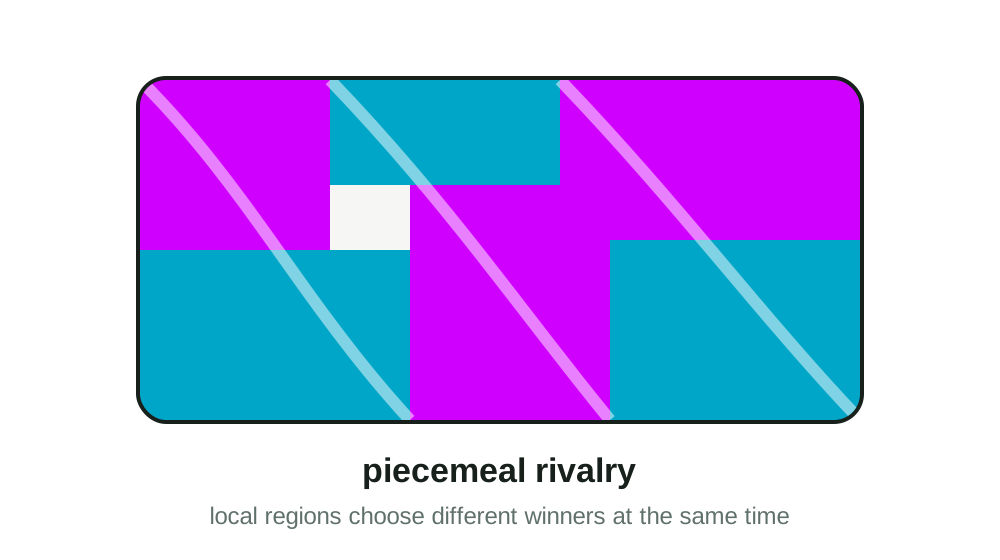
Piecemeal rivalry is a useful warning against thinking of consciousness as a single switch. It can look more like weather across a landscape: local patches change, merge, and spread, while the observer reports whichever pattern covers the larger territory.
Continuous Flash Suppression
Continuous Flash Suppression, or CFS, is a laboratory method for making one eye's image disappear from awareness for longer than ordinary rivalry often allows. One eye sees rapidly changing, high-contrast mask patterns. The other eye sees a quieter target. The masks can keep the target invisible for seconds, sometimes much longer than standard binocular rivalry suppression.5
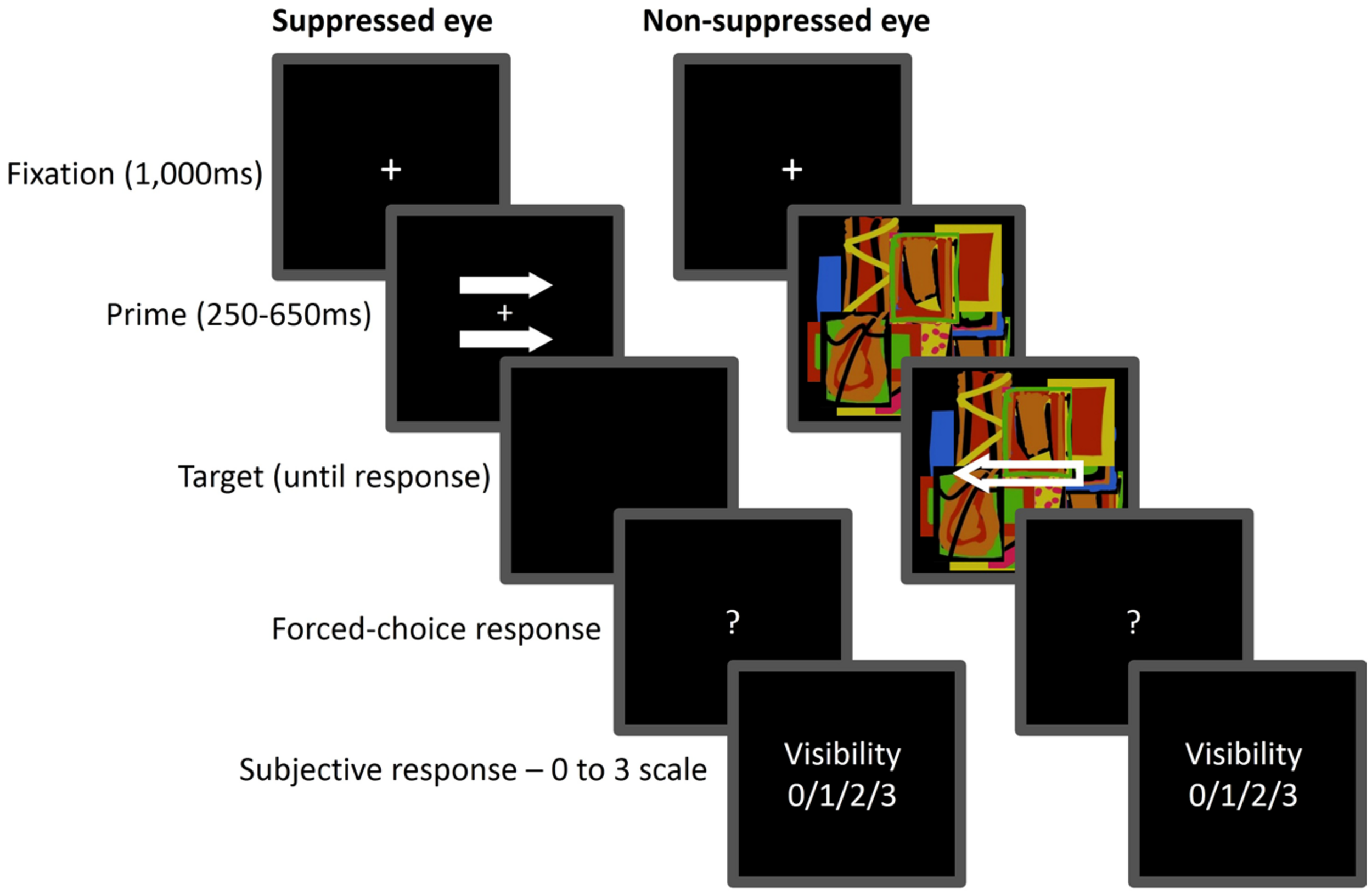
CFS is popular in consciousness research because it lets scientists ask what kinds of processing continue when a stimulus is not consciously seen. But interpretation is delicate. Some studies suggest CFS can strongly disrupt even relatively low-level processing, and apparent high-level "unconscious" effects can depend on partial awareness or task details.6 CFS is therefore powerful, but not a simple invisibility machine.
What to remember
- Fusion, partial fusion, suppression, and rivalry are related outcomes of binocular processing.
- The visual pathway runs from retina to optic nerve, optic chiasm, LGN, V1, V2/V3, V4, and MT.
- Rivalry models have moved from single-stage contests toward distributed and inferential accounts.
- Attention can bias rivalry, but it usually cannot fully control it.
- Piecemeal rivalry shows that dominance can be local, patchy, and dynamic.
- CFS uses rapidly changing masks to prolong interocular suppression, but its results need careful interpretation.
References and further reading
- 1. Blake, R. and Wilson, H. (2011). "Binocular Vision." Vision Research review covering binocular vision, stereopsis, rivalry, and related controversies. Source
- 2. Brascamp, J. W. et al. (2015). "The laws of binocular rivalry: 50 years of Levelt's propositions." Review of Levelt-style rivalry laws and modern perceptual bistability work. Source
- 3. Tong, F., Meng, M. and Blake, R. (2006). "Neural bases of binocular rivalry." Review arguing for rivalry as competition across multiple visual levels. Source
- 4. Hohwy, J., Roepstorff, A. and Friston, K. (2008). "Predictive coding explains binocular rivalry." Predictive and Bayesian framing of perceptual alternation. Source
- 5. Tsuchiya, N., Koch, C., Gilroy, L. A. and Blake, R. (2006). "Depth of interocular suppression associated with continuous flash suppression, flash suppression, and binocular rivalry." Journal of Vision article comparing suppression depth across methods. Source
- 6. Peremen, Z. and Lamy, D. (2014). "Comparing unconscious processing during continuous flash suppression and meta-contrast masking just under the limen of consciousness." Open-access Frontiers article and source of the CFS figure used here under CC BY. Source
- 7. Paffen, C. L. E. and Alais, D. (2011). "Attentional modulation of binocular rivalry." Review of how attention can influence, but does not simply command, rivalry. Source
- 8. "How to Create and Use Binocular Rivalry" (JoVE, 2010). Practical article describing rivalry displays, incomplete suppression, and piecemeal rivalry. Source